

AGM: Scavenging and Waste Anesthetic Gases (WAGs)
The Anesthesia Gas Machine 2026
Michael P. Dosch PhD CRNA (retired), Darin Tharp CRNA MS
Nurse Anesthesia, University of Detroit Mercy
Revised Feb 2026. © Copyright Michael P. Dosch. Use for non-profit purposes only is granted.

10. Scavenging and Waste Anesthetic Gases (WAGs)
- Scavenging Systems
- Definition, Purpose
- Interface-Types
- Practice guidelines
- Components
- Hazards
- Avoiding occupational exposure to waste anesthetic gas
Disposal: Scavenging Systems
Definition and Purpose of scavenging
- Scavenging
- Scavenging is the collection and removal of vented anesthetic gases from the OR. Since the amount of anesthetic gas supplied usually far exceeds the amount necessary for the patient, OR pollution (and the consequent threat to occupational health and the environment) is decreased by scavenging. If a fresh gas flow-sized volume enters the circle breathing circuit each minute, the same flow must leave it, or barotrauma will result.
- Scavenger and operating room ventilation efficiency are the two most important factors in reduction of waste anesthetic gases (WAGs).
Interface- Types
Scavenging may be active (suction applied) or passive (waste gases proceed passively down corrugated tubing through the room ventilation exhaust grill of the OR). Active systems require a means to protect the patient's airway from the application of suction, or buildup of positive pressure. Passive systems require that the patient be protected from positive pressure buildup only.
Another important distinction is that scavenger interfaces may be open (to the atmosphere; modern type) or closed (gases within the interface may communicate with the atmosphere only through valves; the older type). The different types of interface have clinical implications. Clearly, open interfaces are safer for the patient. From being distinctly uncommon, open interfaces have become almost universal on new equipment, so patient (and anesthetists') safety demands user's attention to the distinctions. Open interfaces are found on most newer gas machines (e.g. Aisys, Apollo, Fabius GS). .
Practice guidelines
The Joint Commission requires scavenging. The professional societies publish recommendations. [1]
Recommendation from US OSHA (Occupational Safety & Health Administration): Workers should not be exposed to an eight hour time-weighted average of > 2 ppm halogenated agents (not > 0.5 ppm if nitrous oxide is in use) or > 25 ppm nitrous oxide. Note that no recommended exposure limits have been established for desflurane, isoflurane, or sevoflurane (these guidelines are dated 2000). [2]
Components of the scavenger system
- Gas collection assembly, (tubes connected to APL and vent relief valve)
- Transfer tubing (19 or 30 mm, sometimes yellow color-coded)
- Scavenging interface
- Gas disposal tubing (carries gas from interface to disposal assembly)
- Gas disposal assembly (active or passive - active most common, uses the hospital suction system)
The scavenger interface is the most important component. It protects the breathing circuit from excess positive or negative pressure. Positive-pressure relief is mandatory to vent excess gas in case of occlusion distal to a closed interface. If active disposal system, must have negative pressure relief >as well. Reservoir highly desirable with active systems.
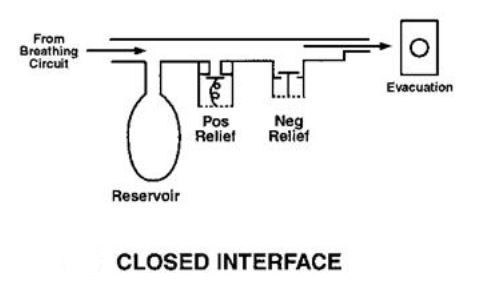
Closed scavenging interface. Click on the link to see the larger version.
Closed interface communicates with the atmosphere only through valves. Should adjust vacuum so that reservoir bag neither flat not over-distended.
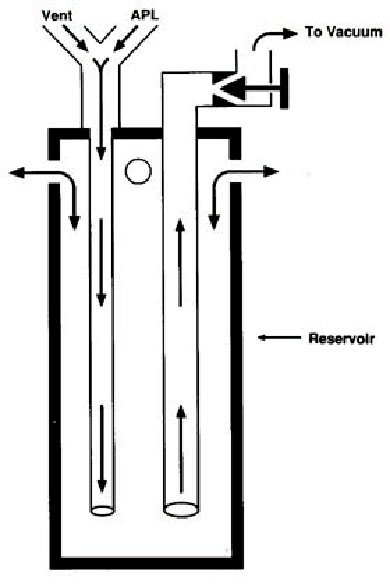
Open interface. Click on the link to see the larger version.
Interfaces can be open or closed types. Open interface has no valves, and is open to atmosphere (allows both negative and positive pressure relief). Should be used only with active systems. Keep the suction indicator between the white etched lines. Remember that slight hissing from an open interface is normal- there is no audible indication of waste gas leaks.
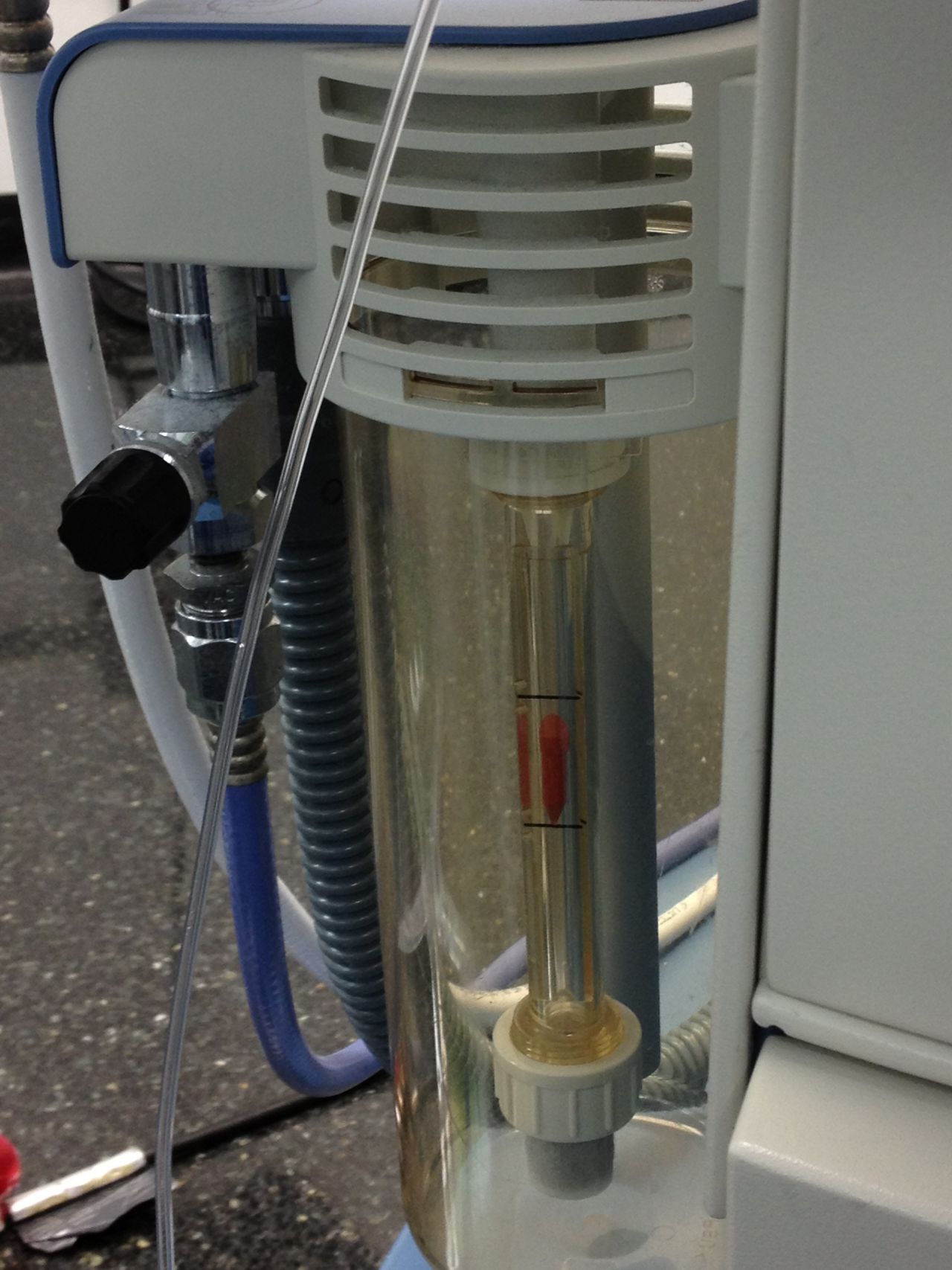
Dräger open scavenging interface. Click on the link to see the larger version.
While safer for the patient (no hazard of positive or negative pressure being applied to the airway as a result of scavenger failure), the risk of occupational exposure for providers ignorant of their proper use is higher with the open interface. [3]
Hazards of scavenging
- Occupational exposure
- And two hazards which are only related to the closed interface
- Obstruction distal to interface causes barotrauma or excess negative pressure (action: disconnect gas collection tubing from back of popoff valve [APL] if possible, or turn off suction at scavenger interface).
- Barotrauma or inability to ventilate
Controlling occupational exposure to waste anesthetic gases
Effectiveness: Scavenging and careful technique can reduce levels of WAGs in our work space to levels at or below that recommended by OSHA.
Avoiding waste gas exposure: Evidence of harm to anesthesia personnel from waste gases is suggestive but unproved (strongest relationship is N 2O and reproductive difficulties). There are definite hazards to patients when scavenging systems fail- so consider the scavenger part of the breathing system and check it each day. The smell of gas during a case is abnormal and the cause should be sought.
Good technique will also help lessen exposure:
- Good mask fit
- Avoid unscavengeable techniques if possible (insufflation)
- Prevent flow from breathing system into room air (only turn on agent and nitrous oxide after mask is on face, turn them off - or pause FGF- before suctioning)
- Washout anesthetics (into the breathing circuit) at the end of the anesthetic
- Don’t spill liquid agent
- Use low flows
- Use cuffed tracheal tubes when possible
- Check the machine regularly for leaks
- Disconnect nitrous oxide pipeline connection at wall at the day’s end (beginning?)
- Total intravenous anesthesia
[1] AANA 2025 Environmental Stewardship in Anesthesia Care: Position Statement, Policy & Practice Considerations. https://issuu.com/aanapublishing/docs/environmental_stewardship_in_anesthesia_care_?fr=xKAE9_-Dctg
[2] Anesthetic Gases: Guidelines for Workplace Exposures at https://www.osha.gov/waste-anesthetic-gases/workplace-exposures-guidelines Accessed Feb 2, 2026
[3] Connell GR, Mangar D. Is Your Scavenger System Functional? Anesth Analg 1992 Dec:75(6):1075.