

AGM: Delivery: Breathing circuits
The Anesthesia Gas Machine 2026
Michael P. Dosch PhD CRNA (retired), Darin Tharp CRNA MS
Nurse Anesthesia, University of Detroit Mercy
Revised Feb 2026. © Copyright Michael P. Dosch. Use for non-profit purposes only is granted.

6. Delivery: Breathing circuits
- Classification
- Breathing circuits- Non rebreathing (Mapleson and Bain)
- How do they work?
- Fresh gas flow requirements
- Pethick Test for the Bain Circuit
- Circle System
- Circle system
- King (limb within limb)
- Advantages and disadvantages
- Circle system
Breathing circuit classification
The function of any breathing circuit is to deliver oxygen and anesthetic gases, and eliminate carbon dioxide. Carbon dioxide may be eliminated by either washout with adequate fresh gas flow (FGF), or by chemical absorption (soda lime).
Table below is based in part on Mapleson. [1].
| Mode | Reservoir<br/(breathing bag) | Rebreathing | Example |
|---|---|---|---|
| Open | No | No | Open drop |
| Semi-open | Yes | No | NRB, or Circle at high FGF (> V E) |
| Semi-closed | Yes | Yes, partial | Circle at low FGF (< V E) |
| Closed |
Yes |
Yes, complete | Circle (with pop-off valve [APL] closed) |
NRB = Non-rebreathing circuit (e.g. Mapleson D). V E = minute ventilation (RR x V T). FGF = Fresh gas flow.
- The Circle system can be either
- closed (FGF exactly = patient uptake, complete rebreathing after carbon dioxide absorbed, and APL closed)
- semi-closed (some rebreathing occurs, FGF and APL settings at intermediate values), or
- semi-open (no rebreathing, high FGF [> V E])
- open - no valves, no reservoir: for example open drop ether, or a nasal cannula. In either, the patient has access to atmospheric gases.
Non-rebreathing (Mapleson) breathing circuits
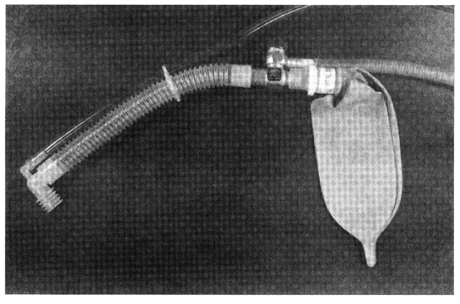
Mapleson D. Click on the link to see the larger version.
-
-
-
- All non-rebreathing (NRB) circuits lack unidirectional valves and soda lime carbon dioxide absorption.
- Work of breathing is low in all (no unidirectional valves or soda lime granules to create resistance).
- The amount of rebreathing is highly dependent on dilution of expirations with high FGF in all.
- Minimum FGF: In practice, most anesthetists will provide a minimum 5 L/min for children on up to adults to prevent rebreathing (or 2-3 x VE, whichever is greater).
-
-
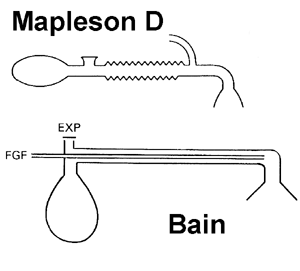
Mapleson D and Bain NRB circuit. Click on the link to see the larger version.
The Bain circuit is a "coaxial" Mapleson D- the same components, but the fresh gas flow tubing is directed within the inspiratory limb, with fresh gas entering the circuit near the mask. Fresh gas flow requirements are similar to other NRB circuits. The Bain has been shown to add more heat and humidity to inhaled gases than other Mapleson circuits.
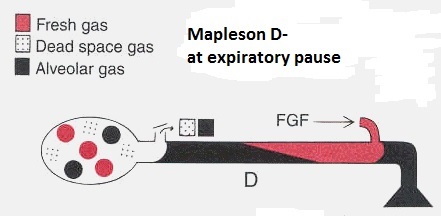
Mapleson D - how it works. Click on the link to see the larger version.
How do NRB’s work? During expiration, FGF pushes exhaled gas down the expiratory limb, where it collects in the breathing bag and opens the expiratory valve (pop-off or APL). The next inspiration draws on the gas which is nearest in the expiratory limb (primarily FGF). The expiratory limb will have less carbon dioxide (less rebreathing) if FGF inflow is high, V T is low, and the duration of the expiratory pause is long (a long expiratory pause is desirable as exhaled gas will be flushed more thoroughly). All NRB circuits are convenient, lightweight, easily scavenged. One objection is that switching the breathing circuit back and forth between circle and Mapleson between cases introduces the possibility of misconnections.
The Pethick Test for the Bain Circuit- A unique hazard of the use of the Bain circuit is occult disconnection or kinking of the inner, fresh gas delivery hose. If this occurs, the entire corrugated limb becomes dead space. This results in respiratory acidosis which is unresponsive to increased minute ventilation. To perform the Pethick test:
- Occlude the patient's end of the circuit (at the elbow).
- Close the APL valve.
- Fill the circuit, using the oxygen flush valve.
- Release the occlusion at the elbow and flush. A Venturi effect flattens the reservoir bag if the inner tube is patent.
Dorsch & Dorsch give a second test. [2]. If fresh gas flow is established, and the inner tube is occluded, the flowmeter bobbins (if present) should dip (due to back pressure) if the inner tube is patent.
Circle Breathing Circuit
The circle is the most common breathing system. It cleanses carbon dioxide from the patient’s exhalations chemically, which allows rebreathing of all other exhaled gases (a unique breathing arrangement in health care, but rebreathing is used extensively in other environments e.g. space, submarine).
Good resources for understanding the circle and the role of each of their components are
- How anesthesia circle breathing systems work explained simply (also see Part 2 & 3)
- Visit Deranged Physiology: Breathing circuits which discusses the circle and the role of each component, how it differs from ICU ventilator circuits, also non-rebreathing circuits
Circle Diagrams
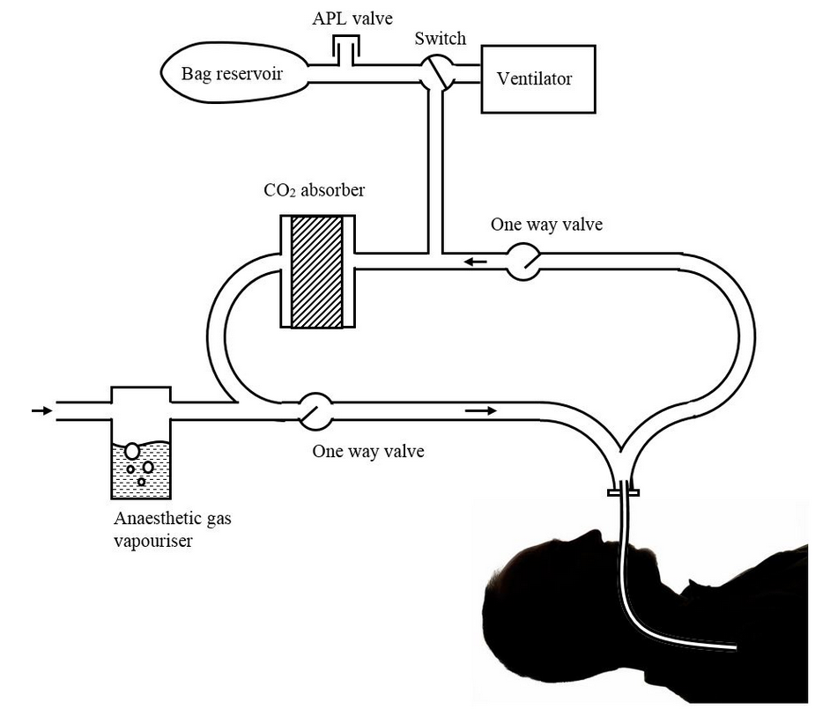
Circle breathing circuit from Deranged Physiology: Breathing circuits for manual and mechanical ventilation. Click on the link to see the larger version.
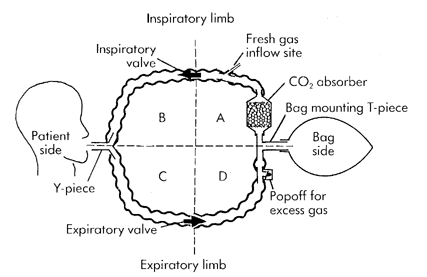
Circle system. Click on the link to see the larger version.
- Circle components: fresh gas inflow source, inspiratory & expiratory unidirectional valves, inspiratory and expiratory corrugated tubing, Y connector, overflow (called popoff, adjustable pressure-limiting valve, or APL valve), reservoir bag, carbon dioxide absorbent canister and granules.
- Resistance of circle systems is less than 3 cm H 2O (less than the resistance imposed by the endotracheal tube).
- Dead space is increased (by all respiratory apparatus). V D/V T= 0.33 normally, 0.46 if intubated and 0.65 if mask case. Mechanical dead space ends at the point where inspired and expired gas streams diverge (the Y-connector).
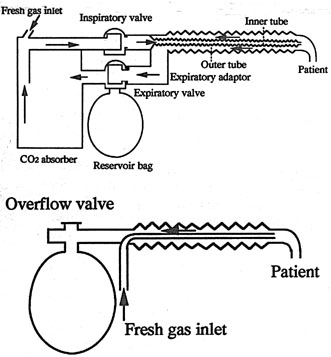
King circuit (top) compared to the Bain. Click on the link to see the larger version.
A "Universal F" or "Mera F" circuit (King TM circuit) is a coaxial circle system, with the inspiratory limb contained within the expiratory. Like a Bain, it is less bulky, and may offer more heat and humidification of the inspired gases. Like the Bain, occult disconnection or kinking of the inner limb causes a huge increase in dead space and respiratory acidosis. [3], [4]. . This respiratory acidosis does not respond to increased minute ventilation- if exhaled gases are not forced through the absorbent granules, no amount of ventilation will cleanse carbon dioxide from the patient's exhalations. The tests for inner tube patency which can be used for a Bain circuit are not readily adaptable to the King circuit.
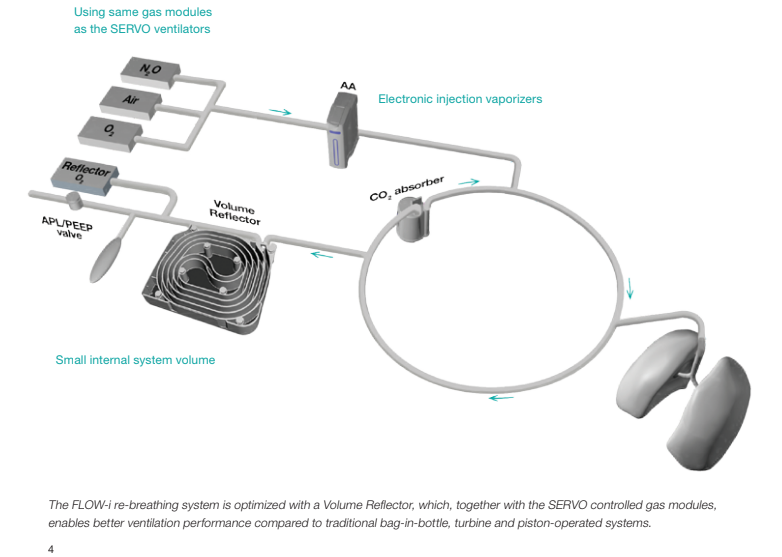
The Flow-i (and Mindray A9) use a volume reflector in the circle. Click on the link to see the larger version.
Circle system advantages and disadvantages
Circle advantages:
- constant inspired concentrations
- conserve respiratory heat and humidity
- useful for all ages (may use down to 10 kg, about one year of age, or less with a pediatric disposable circuit)
- useful for closed system or low-flow
- low resistance (less than tracheal tube, but more than a NRB circuit)
Circle disadvantages:
- increased dead space
- malfunctions of unidirectional valves
[1] Mapleson WW. The elimination of rebreathing in various semi-closed anaesthetic systems. Br J Anaesth. 1954 Sep;26(5):323-32. doi: 10.1093/bja/26.5.323.
[2] Dorsch JA, Dorsch SE. Understanding Anesthesia Equipment 5th ed. 2008:942
[3] Nakae Y, Miyabe M, Sonoda H, Tamiya K, Namiki A. Comparison of the Jackson-Rees circuit, the pediatric circle, and the MERA F breathing system for pediatric anesthesia. Anesth Analg. 1996 Sep;83(3):488-92. doi: 10.1097/00000539-199609000-00008.
[4] Jellish WS, Nolan T, Kleinman B. Hypercapnia related to a faulty adult co-axial breathing circuit. Anesth Analg. 2001 Oct;93(4):973-4, table of contents. doi: 10.1097/00000539-200110000-00034.