

Occupational Therapy

Lead Change. Design Impact. Transform Lives.
 Detroit Mercy's Occupational Therapy program is designed for the next generation of changemakers in healthcare. Graduates of the program are prepared to be compassionate practitioners, critical thinkers and responsible leaders who advocate for occupational participation, promote health and wellbeing and contribute to positive change within the communities and systems they serve.
Grounded in Detroit and shaped by our commitment to educating the whole person, our graduates lead with purpose, adapt with resourcefulness and practice with the conviction that occupational therapy — done well — transforms lives.
Three Pathways. One Transformative Experience.
- Master of Science in Occupational Therapy (MSOT): Five semesters, hybrid format, fastest path to licensure in Michigan
- Doctor of Occupational Therapy (OTD): Eight semesters, hybrid format, built in concentrations
- Post-Professional Doctor of Occupational Therapy (ppOTD): Two years part-time, 100% online
Whether you pursue the master's or a doctoral degree path, you'll gain hands-on experience, community-based learning and mentorship that prepare you to thrive in today's dynamic healthcare landscape.
Online Information Sessions
Health Sciences and Sports and Exercise Sciences
Click the date below to register.
Tuesday, October 13, 6:00 p.m.
Tuesday, November 10, 12:00 p.m.
Tuesday, December 8, 6:00 p.m.
-
Curricular Threads
 Our Occupational Therapy program is intentionally designed around six curricular threads:
- Belonging – Belonging is the recognition that every person is inherently worth of occupational participation, dignity and inclusion. Students develop professional identity as members of an inclusive OT knowledge community, learning to advocate for belonging in every setting they serve.
- Readiness – Readiness is the belief that our graduates don’t just know occupational therapy, they are prepared to practice it in real settings with real people from the moment they enter professional practice. Students develop occupation-centered knowledge, clinical judgment and professional habits to meet people where they are.
- Innovation – Innovation is the conviction that occupational therapists don’t just work within systems, they challenge and redesign them to build something better for the people those systems have failed. Students develop the capacity to identify barriers to occupational therapy delivery models to promote access to quality care.
- Doing – Doing is built on the foundation that you cannot think your way to becoming an occupational therapist, you must live it. Students develop competence, confidence and sustainable professional habits by learning though doing.
- Growth – Growth is the commitment that every student who enters the program leaves more fully themselves — as a thinker, practitioner and person. Students develop critical thinking skills, reflective capacity and professional identity that deepens across the curriculum.
- Engagement – Engagement is what is required to thrive as a student, become a responsive practitioner and to contribute meaningfully to the profession and people it serves. Students co-construct their learning, taking active ownership of the practitioners they are becoming.
Built on Human-Centered Design
Our curriculum is intentionally designed around students, clients and communities to ensure that every learning experience is relevant, flexible and engaging.
Designed Around Students
A curriculum intentionally built around the learner's developmental journey, with built-in sustainability features to prevent burnout.
Career Readiness
Evidence-based, innovative practice across diverse settings guided by principles of mercy, compassion and justice.
Engaged Learning
Interactive labs, real-world projects and Detroit-based partnerships that put you at the center of community transformation – living out our commitment to serving and leading in Detroit.
Well-Being & Belonging
A supportive, inclusive environment that values the whole person and cultivates genuine belonging across differences.
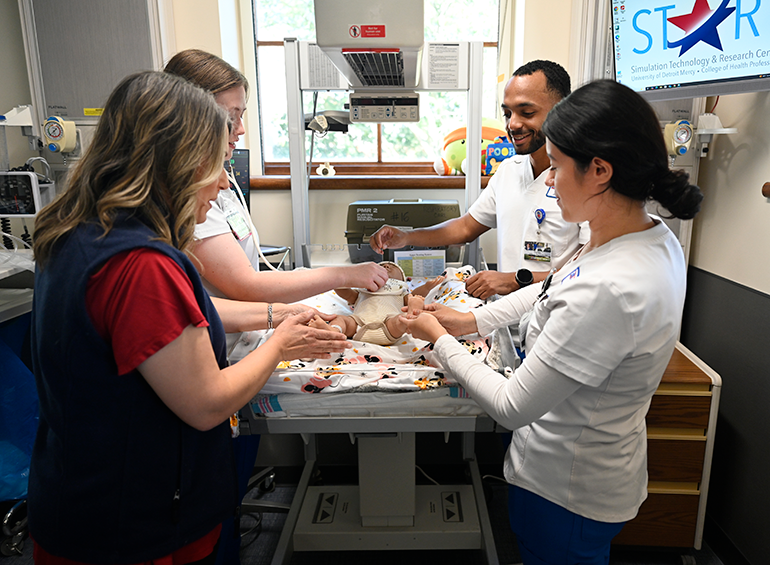



Join the future of Occupational Therapy
At Detroit Mercy, you'll learn to design solutions that make a difference — for individuals, families and communities.
Be part of a program built for the future of health, grounded in the heart of Detroit.
 "Occupational therapy transforms lives by focusing on what matters most, helping people participate fully in everyday life. At UDM, we've intentionally designed a hands-on program with students at the center. It bridges classroom learning with real-world experience, preparing graduates to lead with compassion, confidence, and purpose. We're not just training occupational therapists to work within today's systems. We're preparing bold leaders to transform them. If you want to be a part of that change, we're ready for you."
— Amy Lamb, OTD, OTR/L, FAOTA, NBC-HWC, Chair of Occupational Therapy
Programs
-
MSOT
Master of Science in Occupational Therapy (MSOT)
Total Credits: 60Professional Year 1
Summer
- OCT 5130: Applied Human Anatomy — 3 credits
- OCT 5131: Foundations of Occupational Therapy — 3 credits
- OCT 5132: Thriving in Practice Seminar — 1 credit
- OCT 5133: Occupation as Core — 1 credit
- OCT 5134: Functional Movement Analysis & Assessment — 2 credits
- OCT 5135 Evidence-Based Practice I — 1 credit
Fall
- OCT 5210: Applied Neuroscience Across the Lifespan — 3 credits
- OCT 5211: Occupational Analysis & Adaptation (7 wks) — 1 credit
- OCT 5212: Occupational Performance in Phys Rehab I (7 wks) — 2 credits
- OCT 5213: Disease Prevention & Health Promotion — 3 credits
- OCT 5214: Occupational Performance in Phys Rehab II (8 wks) — 3 credits
- OCT 5215: Practice Immersion I & Seminar — 3 credits
- OCT 5216: Evidence-Based Practice II — 1 credit
- Interprofessional Practice & Leadership — 0 credits
Winter
- OCT 5320: Evidence Based Practice III — 3 credits
- OCT 5321: Occupational Performance in Mental Health (7 wks) — 2 credits
- OCT 5322: Professional Leadership & Management — 3 credits
- OCT 5323: Practice Immersion II & Seminar — 3 credits
- OCT 5324: Occupational Performance in Community (8 wks) — 3 credits
Professional Year 2
Summer
- OCT 6431: Practice Immersion III & Seminar — 3 credits
- OCT 6432: Occupational Performance Children & Adolescents I — 4 credits
- OCT 6433: Level II Fieldwork A1 — 3 credits
Fall
- OCT 6510: Level II Fieldwork A2 — 3 credits
- OCT 6511: Level II Fieldwork B — 6 credits
*The entry-level occupational therapy master’s degree program has applied for accreditation by the Accreditation Council for Occupational Therapy Education (ACOTE) of the American Occupational Therapy Association (AOTA), located at 7501 Wisconsin Avenue, Suite 510E, Bethesda, MD 20814. ACOTE’s telephone number c/o AOTA is (301) 652-AOTA and its web address is www.acoteonline.org. The program must be granted Candidacy Status, have a preaccreditation review, complete an on-site evaluation, and be granted Accreditation Status before its graduates will be eligible to sit for the national certification examination for the occupational therapist administered by the National Board for Certification in Occupational Therapy (NBCOT). After successful completion of this exam, the individual will be an Occupational Therapist, Registered (OTR). In addition, all states require licensure to practice; however, state licenses are usually based on the results of the NBCOT Certification Examination. A felony conviction may affect a graduate’s ability to sit for the NBCOT certification examination or attain state licensure.
The program is scheduled to launch in May 2027. The UDM Entry-Level Master’s program has applied for accreditation by the Accreditation Council for Occupational Therapy Education (ACOTE) of the American Occupational Therapy Association (AOTA). Pending approval, the inaugural master’s cohort would graduate in Fall 2028, and the inaugural doctoral cohort would graduate in Fall 2029.
MSOT Graduation requirement:
Students must complete all coursework and fieldwork to graduate. All Level II fieldwork experiences must be completed within 24 months of the scheduled Level II completion date. Anticipate MSOT students to graduate in December 2028, eligible to sit for the NBCOT exam beginning January 2029.Standard A.4.4. Published Policies and Procedures
For tuition costs, visit the Student Accounting page.
Technology, Supplies and Loan Fees (estimated as of 8/6/2026) Fees and Costs Year 1 Semester 1 Year 1 Semester 2 Year 1 Semester 3 Year 2 Semester 4 Year 2 Semester 5 TOTAL Tuition
15,000
15,000
15,000
15,000
10,000
70,000
Technology Fee
$500
$500
$500
$500
$500
$2,500
Books & Supplies
$500
$500
$500
$500
$0
$2,000
Loan Fees
$109
$109
$109
$109
$109
$545
Distance Education Fees
$0
$0
$0
$0
$0
$0
TOTAL $16,109
$16,109
$16,109
$16,109
$10,609
$75,045
-
OTD
Entry-Level Doctor of Occupational Therapy (OTD)
Total Credits: 90Professional Year 1
Summer
- OCT 5130: Applied Human Anatomy — 3 credits
- OCT 5131: Foundations of Occupational Therapy — 3 credits
- OCT 5132: Thriving in Practice Seminar — 1 credit
- OCT 5133: Occupation as Core — 1 credit
- OCT 5134: Functional Movement Analysis & Assessment — 2 credits
- OCT 5135 Evidence-Based Practice I — 1 credit
Fall
- OCT 5210: Applied Neuroscience Across the Lifespan — 3 credits
- OCT 5211: Occupational Analysis & Adaptation (7 wks) — 1 credit
- OCT 5212: Occupational Performance in Phys Rehab I (7 wks) — 2 credits
- OCT 5213: Disease Prevention & Health Promotion — 3 credits
- OCT 5214: Occupational Performance in Phys Rehab II (8 wks) — 3 credits
- OCT 5215: Practice Immersion I & Seminar — 3 credits
- OCT 5216: Evidence-Based Practice II — 1 credit
- Interprofessional Practice & Leadership — 0 credits
Winter
- OCT 5320: Evidence Based Practice III — 3 credits
- OCT 5321: Occupational Performance in Mental Health (7 wks) — 2 credits
- OCT 5322: Professional Leadership & Management — 3 credits
- OCT 5323: Practice Immersion II & Seminar — 3 credits
- OCT 5324: Occupational Performance in Community (8 wks) — 3 credits
Professional Year 2
Summer
- OCT 6431: Practice Immersion III & Seminar — 3 credits
- OCT 6432: Occupational Performance Children & Adolescents I — 4 credits
- OCT 6433: Level II Fieldwork A1 — 3 credits
Fall
- OCT 6510: Level II Fieldwork A2 — 3 credits
- OCT 6511: Level II Fieldwork B — 6 credits
Winter
- OCT 6620: Human-Centered Innovation I: Understanding Populations — 2 credits
- OCT 6621: Implementation Science in OT Practice — 2 credits
- OCT 6622: Doctoral Capstone Preparation Seminar I — 1 credit
- OCT 6623: Advanced Policy & Advocacy — 3 credits
- Electives for Specialization — 3 credits
Professional Year 3
Summer
- OCT 7730: Human-Centered Innovation II: From Co-Creation to Impact — 3 credits
- OCT 7731: Implementation Science in Action: From Design to Dissemination — 3 credits
- OCT 7732: Doctoral Capstone Preparation Seminar II — 1 credit
- Electives for Specialization — 3 credits
Fall
- Electives for Specialization — 3 credits
- OCT 7810: Doctoral Capstone Experience (14 wks) — 6 credits
**The entry-level occupational therapy doctoral degree program has applied for accreditation by the Accreditation Council for Occupational Therapy Education (ACOTE) of the American Occupational Therapy Association (AOTA), located at 7501 Wisconsin Avenue, Suite 510E, Bethesda, MD 20814. ACOTE’s telephone number c/o AOTA is (301) 652-AOTA and its web address is acoteonline.org. The program must be granted Candidacy Status, have a preaccreditation review, complete an on-site evaluation, and be granted Accreditation Status before its graduates will be eligible to sit for the national certification examination for the occupational therapist administered by the National Board for Certification in Occupational Therapy (NBCOT). After successful completion of this exam, the individual will be an Occupational Therapist, Registered (OTR). In addition, all states require licensure to practice; however, state licenses are usually based on the results of the NBCOT Certification Examination. Note that a felony conviction may affect a graduate’s ability to sit for the NBCOT certification examination or attain state licensure.
The program is scheduled to launch in May 2027. The UDM Entry-Level OTD Program has applied for accreditation by the Accreditation Council for Occupational Therapy Education (ACOTE) of the American Occupational Therapy Association (AOTA). Pending approval, the inaugural master’s cohort would graduate in Fall 2028, and the inaugural doctoral cohort would graduate in Fall 2029.
OTD Graduation requirement:
Students must complete all coursework, fieldwork, and Capstone projects to graduate. All Level II fieldwork experiences must be completed within 24 months of the scheduled Level II completion date. Anticipate OTD students to graduate in December 2029, eligible to sit for the NBCOT exam beginning January 2030.Standard A.4.4. Published Policies and Procedures
For tuition costs, visit the Student Accounting page.
Technology, Supplies and Loan Fees (estimated as of 8/6/2026) Fees and Costs Year 1 Semester 1 Year 1 Semester 2 Year 1 Semester 3 Year 2 Semester 4 Year 2 Semester 5 Year 2 Semester 6 Year 3 Semester 7 Year 3 Semester 8 TOTAL Tuition
$15,000
$15,000
$15,000
$15,000
$10,000
$10,000
$10,000
$10,000
$100,000
Technology Fee
$500
$500
$500
$500
$500
$500
$500
$500
$4,000
Books & Supplies
$500
$500
$500
$500
$0
$500
$500
$0
$3,000
Loan Fees
$109
$109
$109
$109
$109
$109
$109
$109
$872
Distance Education Fees
$0
$0
$0
$0
$0
$0
$0
$0
$0
TOTAL
$16,109
$16,109
$16,109
$16,109
$10,609
$11,109
$11,109
$10,609
$107,872
-
ppOTD
Post-Professional Doctor of Occupational Therapy (ppOTD)
Total Credits: 31Year 1
Summer
- OCT 6621: Implementation Science in OT Practice — 2 credits
- OCT 7731: Implementation Science in Action: From Design to Dissemination — 3 credits
Fall
- OCT 6620: Human-Centered Innovation I: Understanding Populations — 2 credits
- OCT 7730: Human-Centered Innovation II: From Co-Creation to Impact — 3 credits
Winter
- OCT 7740: Designing Learning: Curriculum Foundations — 2 credits
- OCT 7741: Teaching for Impact: Strategies for Engaged & Inclusive Learning — 3 credits
Year 2
Summer
- OCT 6623: Advanced Policy & Advocacy — 3 credits
- OCT 7820: Doctoral Project I — 0.5 credits
- Electives for Specialization — 3 credits
Fall
- OCT 7821: Doctoral Project II — 0.5 credits
- Electives for Specialization — 3 credits
Winter
- OCT 7822: Capstone — 3 credits
- Electives for Specialization — 3 credits
*As part of the post-professional OTD curriculum, students may pursue elective concentration tracks in Advocacy for Systems Change (policy, advocacy, and change leadership) or Trauma-Informed Care (trauma-informed practice across settings), allowing them to tailor their doctoral studies to their professional interests and career goals
-
OT Program Handbook
Applying
-
MSOT/OTD Application Requirements and Applying
Qualified applicants will complete the following prerequisites
A bachelor's degree from an accredited institution is required prior to starting the program, though applicants may apply before completing their degree. No specific undergraduate major is required, provided all prerequisite courses (listed below) are completed.
- Human Anatomy (with lab)
- Human Physiology (with lab)
- Developmental Psychology
- Statistics
- Sociology
- Medical Terminology
To apply for admission, students must submit the following:
- Official transcripts
- Three letters of recommendation
- Personal statement
- Minimum undergraduate GPA: 3.0 cumulative from an accredited institution
Process for MSOT/OTD Applications
- Applications open August through February
- Applications submitted through OTCAS (OT Centralized Application Service).
- Selected applicants are invited to an interview with faculty
- Applicants notified no later than March 1
- Accepted applicants start the program that May
-
ppOTD Application Requirements and Applying
Qualified applicants will have:
- Minimum of a master's degree in Occupational Therapy from an accredited institution
- Minimum of one year practicing as a licensed Occupational Therapist (or permission of Admissions Committee)
- Completed application including official transcripts, three references, statement of professional goals.
- Minimum GPA of 3.0 in prior studies.
To apply for admission, students must submit the following:
- Application statement of purpose and practice goals
- Current resume, official transcripts from all colleges/universities attended
- Copy of NBCOT certification
- Copy of current state license/certification in a U.S. jurisdiction
- For international students: Official Test of English as a Foreign Language (TOEFL) with a minimum score of 550 (213 if computer generated)
- Three letters of recommendation (one recommendation must be from a licensed occupational therapist)
-
Program Outcomes
Standard 4.2 Publication of Program Outcomes
MSOT program
Sample Table Graduation Year
Students Entering
Students who withdrew or did not graduate for non-academic reasons
Students Graduating
Graduation Rate*
2028
0
0
0
NA
2029
0
0
0
NA
2030
0
0
0
NA
Total
0
0
0
NA
* The University of Detroit Mercy Master of Occupational Therapy program anticipates its first graduating cohort to complete their program in the Fall of 2028, and the program will have graduation rates provided in 2029.
Pending successful accreditation, students will be eligible to take the certification exam through National Board for Certification in Occupational Therapy (NBCOT®) following graduation in the Fall of 2028 with NBCOT pass rates available in 2030.
OTD program
Sample Table Graduation Year
Students Entering
Students who withdrew or did not graduate for non-academic reasons
Students Graduating
Graduation Rate*
2029
0
0
0
NA
2030
0
0
0
NA
2031
0
0
0
NA
Total
0
0
0
NA
* The University of Detroit Mercy Master of Occupational Therapy program anticipates its first graduating cohort to complete their program in the Fall of 2029, and the program will have graduation rates provided in 2030.
Pending successful accreditation, students will be eligible to take the certification exam through National Board for Certification in Occupational Therapy (NBCOT®) following graduation in the Fall of 2029 with NBCOT pass rates available in 2030.